
4 Ways to Stop a Self-Fulfilling Prophecy
You might have heard of self-fulfilling prophecies, but I promise you, they can be hidden in our daily thinking and are extremely difficult to unroot.
Self-fulfilling prophecies can infiltrate anywhere you perform such as work, school, sports - it is a perspective and expectation that steals the fruits of your labor.
It’s crucial to conquer your self-fulfilling prophecies so you can perform at your best and find pleasure in your play on an everyday basis.
In this article, I will describe what a self-fulfilling prophecy is and four methods you can use to stop it in its tracks.
What is a Self-Fulfilling Prophecy?
The term self-fulfilling prophecy was first coined by sociologist Robert K. Merton in 1948 - it was used to describe a process where our predictions of the future can impact our outcomes.
Your predictions can be about yourself, others, the future - these predictions could be so terrifying that this perspective manifests calamity in your daily life.
Self-fulfilling prophecies are expectations that we inadvertently bring into fruition.
At it's core may be deeply held beliefs that spur action or inaction, contributing to the result that you feared would happen.
Once your self-fulfilling cycle is complete, and you led yourself to what you feared, then those harsh beliefs are strengthened by the supposed evidence you now have - leading to more self-fulfilling prophecies in the future.
However, you do have a chance today - you can stop your self-fulfilling prophecies right now, and I have a model to show you how to do that.
CBT Cycle
What you're Looking at is a typical Cognitive Behavioral Treatment (CBT) model - it explains the cascading effects that underlie self-fulfilling prophecies.
Simply put:
Negative thoughts often stimulate negative feelings.
Negative feelings can alarm the body with physical sensations.
Physical sensations create physical distress.
Physical distress requires undesirable behavior to calm down.
Undesirable behaviors reinforce the negative thoughts that started it all in the first place.
Robert K. Merton's model of a self-fulfilling prophecy fits right into the CBT cycle.
It starts with negative thoughts, like self-doubt, shame, and blame - and it ends with making those beliefs seem more true.
However, if I’m going to show you each step to beating a self-fulfilling prophecy, you need to accept one simple fact to make sure you don’t stop before you start.
Self-Fulfilling Prophecies are NOT Failures
At the very beginning of a self-fulfilling prophecy are thoughts and beliefs.
If you read this article and guilt yourself because you have experienced self-fulfilling prophecies, you’re only setting the foundation for your next one.
A self-fulfilling prophecy is simply a habit - a habit that does not reflect character, abilities, or worth as a human being.
If you’re going to move forward with each step to beat a self-fulfilling prophecy, you need a solid foundation of understanding for yourself and openness to change, that doesn’t require you to beat yourself up or self-criticize.
Also, if you notice some strong beliefs underlying these spirals, I would consider seeing a mental health professional to get to the root of them - life experiences can setup nearly invisible beliefs about yourself that can permeate every aspect of your daily life, so its best to let a therapist help you identify what those are.
Nonetheless, you can still try to barricade each of the four components of the CBT cycle.
4 Ways to Barricade a Self-Fulfilling Prophecy Spiral
In that CBT cycle, I mentioned four different transactions that occur - making up the cascading spiral of a self-fulfilling prophecy.
The good news is that each time you jump from one circle to the next, you have a chance to barricade - to stop the flow.
If you can’t stop it, then the spiral will do another circuit, meaning you have four more chances to help yourself break the spiral.
Let’s start with the first stage between thoughts and emotions.
1 - Cognitive Challenging
The first opportunity to stop a self-fulfilling prophecy is cognitive challenging.
This is a clinical term for sifting through which thoughts are accurate and/or constructive - verifying the credibility of each thought you notice.
Not all thoughts are true, and you don’t have to accept every one that pops into your head.
For a self-fulfilling prophecy to move from thoughts to emotions, an awful and inaccurate thought is often believed as true.
This usually entails one of three perspectives:
Something bad is true about you - “I am lesser than everyone else”
Something bad is true about others - “I can’t trust anybody”
Something bad is true about the future - “Nothing good is ever going to happen”
If you believes these thoughts, then you might be validating an unreliable message - you might be accepting a belief that isn’t true.
Instead, I urge you to cognitively challenge yourself - think of it like a metal detector for your thoughts, screening each as they pass through.
If any dangerous or absolutist thoughts come in and signal the alarm, pull them to the side and ask them more questions.
Is this really true?
Is this true all the time?
What makes this true only some of the time?
If its only true some of the time, doesn’t that make the belief wrong some of the time?
If the belief is sometimes wrong, then couldn’t it be a wrong belief?
This doesn't mean shutting out all self-awareness, but it means finding which thoughts and beliefs are credible enough to act on.
When you recognize negative thoughts that can kick off a self-fulfilling prophecy, take at least 5 minutes to interrogate them.
If it's too late to challenge thoughts, and you notice they’ve already elicited plenty of negative emotions, it's time to capitalize on the second opportunity to stop the spiral.
2 - Self-Care & Coping Skills
When negative thoughts cause negative feelings, it’s time to manage your emotions.
Negative feelings are usually one of the three:
Anger
Anxiety
Sadness
Each of these emotions actually have additional variations to better specify how you feel - to identify them, try using this feelings wheel:
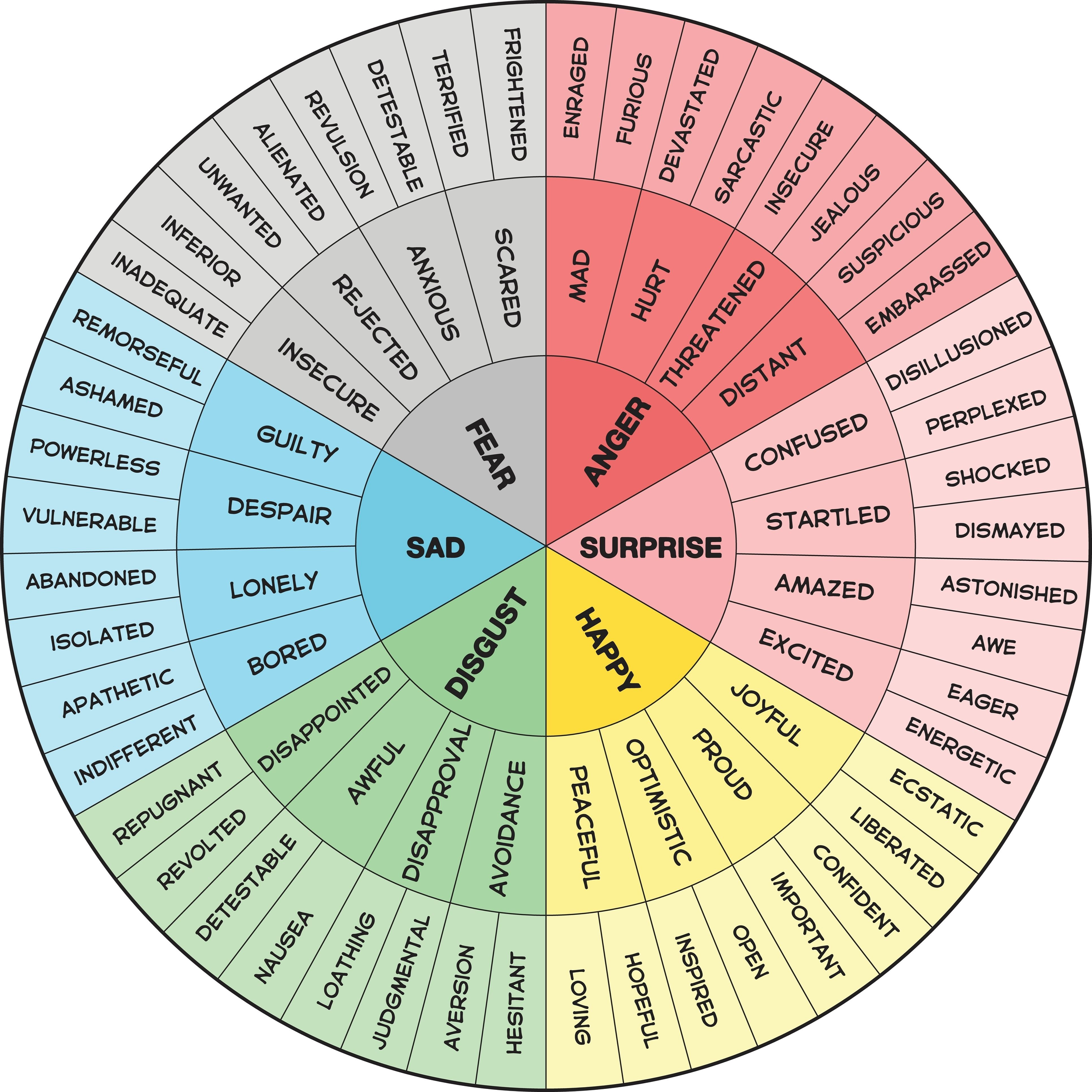
It’s time to start facing your emotions - but in a constructive & considerate way.
It’s time to feel your emotions, identify them, and make appropriate decisions to address them.
The second opportunity to stop a self-fulfilling prophecy is self-care and coping skills - managing your emotions in a constructive way.
This means "making minutes" in your day for activities or time spent actively attempting to calm yourself.
Negative emotions often cause negative physical reactions such as
Increased heart rate
Increased blood pressure
Paresthesia (tingling in fingers or toes)
Numbness
If you don’t start caring for yourself as soon as they sensations start, they often grow into full blown fight, flight, or freeze - which make it significantly harder to return to baseline.
Some activities you can do, as soon as you recognize your emotions, are:
Stepping out of the room for 5 minutes of deep breathing.
A 10 minute walk outside
Journaling for 10 minutes
Spend 20 minutes playing an instrument
Speak with a loved one or trusted friends
If you can practice coping skills & self-care, you can barricade the self-fulfilling prophecy.
However, if the emotions remain untamed and your body is in a physical state of alarm and distress, it’s time to intervene with acceptance of what you’ve done.
3 - Acceptance & Time-Out
The physical sensations of a self-fulfilling prophecy can be disorienting and painful.
In order to eradicate the distress of physical sensations, you might be tempted to engage in a range of unhealthy behaviors.
Oftentimes, our behaviors in response to distress are avoidant - meaning that we are motivated by getting rid of a distress.
This is where we start to engage in some of the following distractions or compulsions:
Doom scrolling
Watching TV
Excessive video game playing
Frantic cleaning
Checking off a To-Do list
Either it be ignoring physical distress, or trying to compulsively solve problems to make it go away, you are still acting as if the false truths behind the whole spiral are true.
Not only are you maintaining your levels of stress or increasing them, but you are accidentally reinforcing the beliefs that start a self-fulfilling prophecy in the first place.
There is a considerable difference between a behavior meant to (1) confront physical distress with self-care and (2) rid of a physical distress to find relief.
Unfortunately, once your physical distress there, its there until you manage it - so its in your best interest to accept it.
Acceptance is the recognition that you are physically distressed - it is the opposite of avoidance.
You don’t need to “approve” of how terrible you feel, you just need to accept the reality of the situation so you can make the choice of advocating for yourself.
You might be quick to deny your distress because your false belief includes the rule that you “shouldn’t” feel distressed - unfortunately, you are, but its not due to the reason that your thoughts might have you believe.
I encourage you to accept your physical distress and treat it with the same kindness you would show a friend.
Pull yourself aside and take a time-out to work it through with yourself - that way you don’t try to compulsively eliminate the distress or distract yourself from it, both of which would only continue the self-fulfilling prophecy.
For example, just a 15 minute time-out is enough time to allow the initial distress of an emotion to pass - you can make a healthy and considerate decision once that time is up and your stress levels have come back down.
If you can’t seem to wait or distract yourself, then you have at one more opportunity to stop the completion of a full self-fulfilling prophecy cycle.
4 - Self-Compassion
In the aftermath of distraction and compulsions is a litany of negative reflections on yourself - shame, guilt, blame, and self-criticism.
The decision was made, the deed was done, and you behaved in a way you don’t approve of.
However, this is where you can make the biggest difference in how you think - hurting yourself over your “failures” is more damaging than the outcomes of most failures.
It’s how you treat yourself once you behaved in a way you’re ashamed of - was your initial thought right?
This is the danger in accidentally confirming each of the three perspectives that start self-fulling prophecies in the first place:
Self - “I was right, I am a terrible person”
Others - “I knew it, I can’t trust anybody”
Future - “It’s true, nothing good will ever happen”
In the aftermath of a self-fulfilling prophecy, you will be tempted to use the outcomes of your recent spiral as evidence that proves what you already thought or believed.
To overcome this last and crucial stage of a self-fulfilling prophecy, I urge you to practice self-compassion with sentences like:
“Self-fulfilling prophecies are hard to manage”
“I’m not the sole factor in any of my outcomes”
“It sucks to think I’m a terrible person”
“It hurts to believe I can’t trust anybody”
“It’s awful that the future seems so catastrophic”
“I’m allowed to feel negative emotions like everybody else”
“I’m permitted to be distracted or frantic sometimes”
“I don’t deserve to hurt my life due to thoughts that hurt me”
Being hard on yourself only sets you up for another self-fulfilling prophecy spiral, which will be stronger and harder to manage.
However, giving yourself compassion only provides a path moving forward - you can still be accountable for changing your ways, but give yourself more chances to do so.
You can change your habits, and you don’t have to live out self-fulfilling prophecies forever.
Final Thoughts
You CAN beat a self-fulfilling prophecy.
In just one cycle between thoughts, feelings, physical sensations, and behaviors your have 4 opportunities to advocate for yourself and your mental health.
You CAN barricade each stage and stop the wheel from turning.
This will be difficult, but I urge you to recognize self-fulfilling prophecies in your life and apply these techniques.
Here are the key take-aways for your journey towards self-advocacy.
You are responsible for stopping your self-fulfilling prophecies
There’s no use in criticizing yourself for the self-fulfilling prophecies of your past.
You have several opportunities to beat a single cycle of a self-fulfilling prophecy
1 - Cognitively challenge your negative thoughts and/or beliefs about yourself, other, and the future
2 - Practice self-care and cope with negative feelings that have come from those thoughts
3 - Accept your physical distress, take care of yourself, and restrain yourself from acting out of negative feelings
4 - Practice self-forgiveness and allow yourself the chance to improve and try again.
